
It’s been another incredibly busy week at Sportstest Towers, so again apologies for my later than planned email and any typos, but I’m rushing to get this out before I’ve got another day of testing ahead of me….yes on a Saturday!
To start the week, or to start the email, some exceptional performances again, before I go on to the interesting stuff about what really helps you guys out.
Firstly, Ollie Evans at World Aquathon Champs in Pontevedra yesterday afternoon. Sounds like a bit of a manic start to the swim, (I’m still waiting on a full race result and photos), but great to see Ollie coming 2nd Brit, and 7th overall! Any outstanding performance!
Last weekend, awesome result by Samantha Trafford at the Morzine-Avoriaz 50k Ultra, which if you know the area includes some fairly mega mountain climbs. Sam had been struggling following a (crossfit induced!) calf injury, but with excellent ongoing treatment from our sports therapist, Eddie, and some great structured training. Sam was really, really pleased to finish just outside her goal time, but placed really well overall in the field. So she is super happy, and again, we’ve got some bigger and wilder Ultra’s coming up for her this summer.
But remember results are not restricted to race and events! In the lab this week some outstanding wins with amazing changes in body composition. Lee popped in to reassess body composition to see an incredible drop in fat mass of over 10kg, and a gain in muscle mass of 1.3kg. Similarly Sunny measured a drop in fat mass of over 5kg….both of these changes have occurred since April!
These just show the importance of regularly assessing what’s going on so we can modify plans and the massive value of following structured bespoke programs, not generic, off the internet, social media driven, outputs.
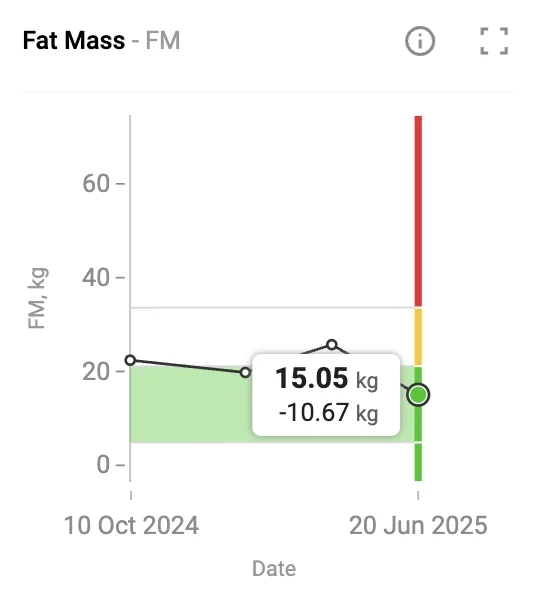
…..massive wins with big changes in body composition!
Finding Balance: When Life, Training, and Recovery Collide
This week, I want to share something that’s been on my mind after observing both my own family and several clients I’ve been working with lately.
It started with my son Seb, who’s been absolutely glued to YouTube recently – watching “day in the life” videos of university-age athletes, particularly American scholarship athletes. Now, while some of it’s educational (thankfully!), what really caught my attention was one particular video where a young athlete was discussing the constant juggling act of balancing studies, training, and social life.
This lad was spot on when he said that quite often you’ll find someone who’s brilliant at their studies and athletics but boring when it comes to being social. Or they’re the life of the party and train like demons, but their academic work suffers. Sound familiar? It got me thinking about how this applies to every single one of us, regardless of whether we’re 13, 33, or 73.
I talk a lot about the balance between training, nutrition, and recovery – those are my big three for performance. But life doesn’t exist in a vacuum, does it? There are family commitments, work pressures, and yes, sometimes we need to acknowledge that our pursuit of personal goals affects those around us.
Take my morning routine, for instance. I’m often out of the house at 5:30 am with the dog for my walk – it’s my headspace time, my thinking time, and frankly, it’s what keeps me sane. But that means Becky’s dealing with getting both kids up, dressed, fed, and ready for school. When I walk back in at 7:30am, everyone’s sorted, and my job is simply to jump in the car and (sometimes) do the school run.
The point is, we all rely on people in our lives to make our routines work. And sometimes, we need to take our foot off the gas and ask ourselves: is the balance right?
When the Balance Goes Wrong, Everything Goes Wrong
Speaking of balance, I had a fascinating consultation last week that perfectly illustrates this principle. I’ve been working with a lady for about five months now – she’s into Hyrox, goes to CrossFit 2-3 times a week, and her main focus is body composition rather than pure performance. We’ve been seeing gradual improvements: fat mass slowly decreasing, muscle mass gradually increasing. Good progress, but not quite as dramatic as I’d expected (or as much as Lee and Sunny who I mentioned before).
So we did a DNA assessment last month, and when we sat down to review the results, everything clicked into place. Her genetics showed she has excellent traits for muscle growth – the kind of genetic profile that should be seeing significant gains. But her genes also indicated that without optimal post-exercise nutrition, she’d likely experience excessive muscle soreness and poor protein resynthesis.
The missing piece? She was leaving the gym and waiting 45 minutes to an hour – sometimes longer – before having anything to eat or drink for recovery.
One small gap in her routine was undermining months of hard work. We’ve now implemented a bespoke targeted post-exercise nutrition strategy, and I’m looking forward to seeing her body composition results next month. It’s a perfect example of “assess, don’t guess” – we could have assumed everything was fine, but the evidence told a different story.
The Danger of Pushing Through When You Shouldn’t
This brings me to another crucial balance point: knowing when to rest. I was reminded of this by a story from about 30 years ago when I was working with an athlete who was showing clear signs of illness. Both his GP and I advised rest – it sounded like a viral infection, and we recommended a couple of total rest followed by a few easy days before any routine carried on.
He decided to carry on training.
The result? That viral infection got into his myocardium (the heart muscle lining), and he ended up needing 6-12 months of virtually complete inactivity! By trying to avoid missing one or two days of training, he lost nearly a year.
Now, that’s an extreme case, but it illustrates a vital principle: rest days aren’t weakness – they’re strategic. I generally follow the rule of thumb: if symptoms are above the neck (minor head cold, sinus issues), you might modify training or carry on carefully. If symptoms are in the chest, complete rest.
Your body is remarkably good at telling you what it needs. Heart RateVariability (HRV) is one tool I use to track this – if it’s trending downward, we need to ask why. Are you not taking the rest and recovery you need? I know I have been asked to talk about HRV in more detail, and I certainly will.
The Endurance Athlete’s Weight Loss Trap
Finally, I want to address something I see far too often: endurance athletes trying to lose weight by simply cutting calories. Yes, I bang on about the importance of optimal weight for performance, but we’ve got to do it sensibly.
Just slashing calories without considering training demands leads to:
Loss of muscle mass
Suppressed immune function
Increased injury risk
Poor recovery between sessions
Many of these can simply be viewed as classic overtraining symptoms, but its all about understanding the root cause!
If your training zones are wrong and you’re not hitting the right intensities, you won’t be using fat as fuel during those long, steady efforts. Then, without proper post-exercise nutrition balanced for your training load and body weight, you’ll see increased muscle soreness and incomplete recovery.
I always tell people: if I was told I could have 1,200 calories a day to lose weight, I’d head straight to the cake shop! It’s not about the number -it’s about the right balance of carbohydrate, fat, and protein AND eating the right things at the right times around your training. If only it was a simple as just counting calories!
The Jigsaw Puzzle of Performance
Everything I’ve talked about today – work-life balance, post-exercise nutrition, knowing when to rest, proper weight management – they’re all pieces of the same jigsaw puzzle. Get one piece wrong, and the whole picture suffers.
The athletes I work with who achieve their goals consistently aren’t the ones who train the hardest or restrict their diets most severely. They’re the ones who understand that sustainable performance comes from getting all these elements working together harmoniously.
As we head into the peak summer training season, I want you to ask yourself: is your balance right? Are you taking care of all the pieces of your performance puzzle, not just the obvious ones?
If you’re struggling with any aspect of this balance – whether it’s nutrition timing, understanding when to rest, or optimising your training zones- that’s exactly what we’re here for.
Remember, taking a step back to assess the big picture isn’t time wasted- it’s often the key to moving forward more effectively.
Keep training smart,
Garry
P.S. I’m genuinely curious about your post-exercise nutritionstrategies. Drop me a message with your favourite post-workout snacks – I’malways looking for new ideas to share with clients!